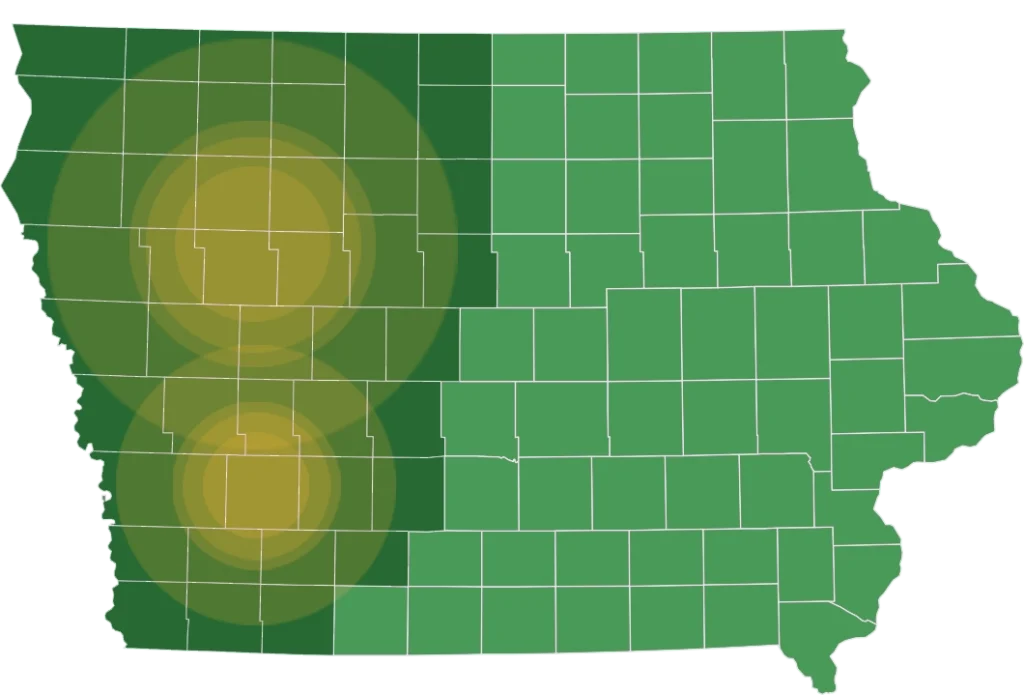
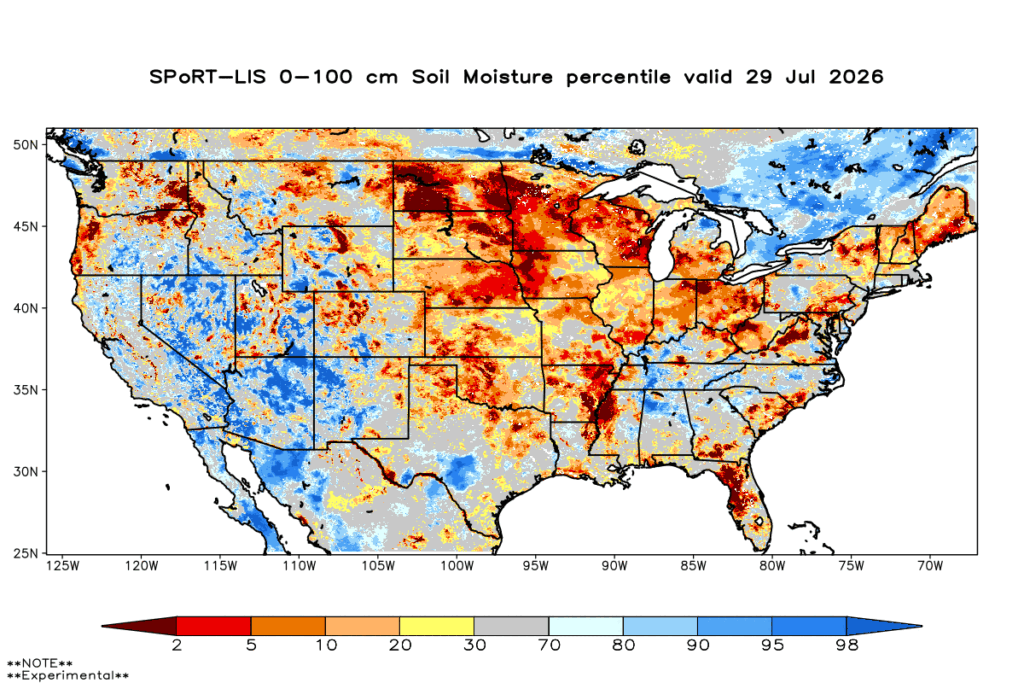

Rainfall amounts over the past two weeks have varied widely across our region, ranging from less than a half inch to more than 3 inches. July temperatures were well above average overall, but fortunately, we avoided the extreme triple-digit heat. The high humidity has actually helped mitigate some of the crop stress (but added to our stress). Our entire region remains too dry, although some areas are worse off than others.
Crop stress is visible in many areas, depending on rainfall and soil type. Higher-quality soils have greater water-holding capacity, lighter-textured / sandy soils have much less ability to hold moisture. So, crops on light soils are showing much more stress.
Looking ahead, the forecast calls for wetter conditions across the region, which is certainly welcome. Unfortunately, temperatures are expected to stay above average for the next two weeks. The continued heat will push the crops to maturity faster, which is not ideal for maximizing yield.
Corn is now in the dough stage. Over the next week or so, kernels will begin to dent and then start to dry down. The kernel counts are already established, but kernel weight is still developing, meaning continued stress at this stage can still reduce corn yields. Disease pressure has remained less than the past two seasons. We can now evaluate pollination and early ear fill. We are seeing more tip-back than usual, although there is a lot of variability. Kernel counts seem to be close to average overall, but drought-stressed areas could still see shallower kernel depth and lower test weights at harvest.
Soybeans generally look good from the road, but like corn, they are showing varying degrees of drought stress. August rainfall is often said to “make” the soybean crop, and so far, some farms are getting it, others are still waiting. Soybeans are currently filling pods and setting new pods at the top of the plant. This is the most important stage for determining yield. Farms that have been missing recent rains need rain soon.
Today’s USDA Supply & Demand report was just released at 11 am. The USDA lowered its estimated U.S. corn yield from 183 bu./acre to 180.7 bu./acre and soybean yield from 53 bu./acre to 52.7 bu./acre. The lower yield estimates were enough to push corn prices about 14 cents higher and soybeans about 9 cents higher immediate after the report. However, the report wasn’t entirely positive news for the markets. The USDA also increased its estimates for planted acres of both corn and soybeans. As a result, total projected U.S. production was actually increased for both crops despite the lower yield estimates.
Use the button on the right to view the past Crop Conditions reports.
Stay informed and connected—subscribe to our mailing list today to receive the latest issues of Today’s Land Owner, Crop Updates, or get notified of auctions and real estate for sale, sent directly in your inbox!